The short answer
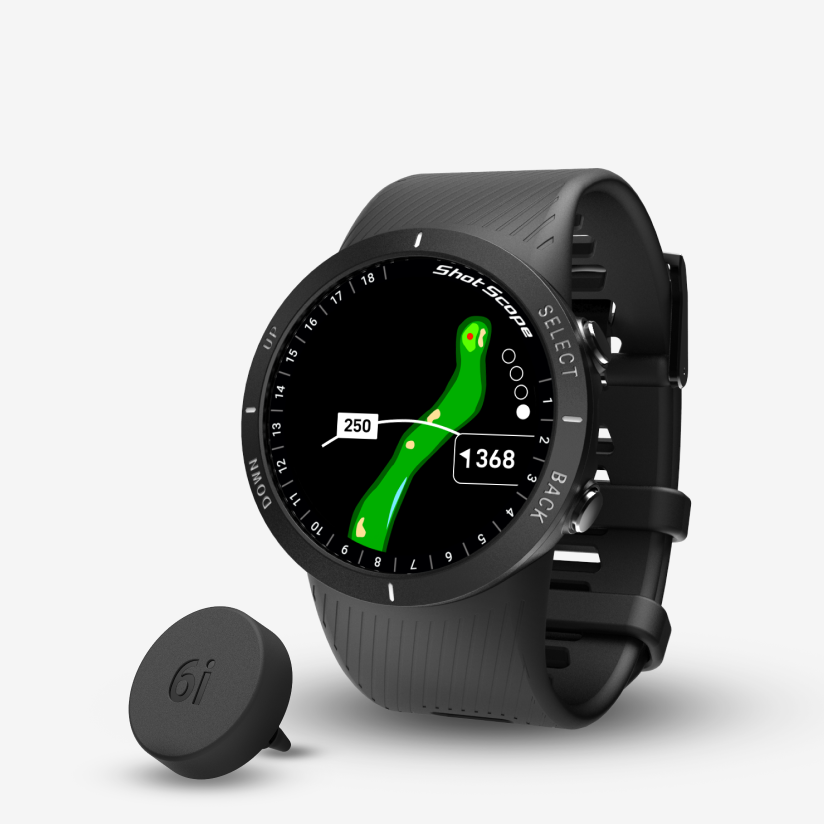
Walking 18 holes takes 4.5–6.5 hours of active GPS. Any watch rated below 15 hours GPS carries real risk on a slow course. The Shot Scope V5 (rated for 2+ rounds, ~30h GPS equivalent) is the safest walking pick — it also auto-tracks every shot so you never fumble with your phone between shots.
GearScout may earn a commission when you buy through links on this page. Prices, availability, and ratings can change, so confirm details with the retailer before purchasing.
Prices last verified June 2026.
If you've ever watched your GPS watch die on the 16th hole while walking a packed Saturday course, you understand the problem this guide solves.
Most GPS watch buyer guides recommend the same watches in the same order regardless of how you play. They optimize for cart riders: plugged in between shots, covered by the cart's charge port if needed. For walkers — who carry or push their bag, keep the watch on their wrist for 5+ uninterrupted hours, and can't stop to check a phone between holes — the calculus is completely different.
Prices last verified June 2026.
The Constraint Filter: What Walking 18 Holes Actually Demands from a Battery
Walking 18 holes is not a 2-hour activity. Here's what the time looks like in practice:
| Scenario | Estimated round time |
|---|---|
| Weekday walking, uncrowded public course | 4.5–5.0 hours |
| Weekend walking, moderate pace | 5.5–6.0 hours |
| Slow weekend public course, busy day | 6.0–6.5 hours |
| Slow-play edge case | 6.5–7.0 hours |
Any GPS watch rated below 15 hours GPS is operating with thin margins on a slow-round day. A watch rated at 10 hours GPS — several popular budget and mid-range models — can die before you reach the 18th green on a 6.5-hour round.
The battery constraint eliminates these options for walkers:
- Voice Caddie T11 LT (10h GPS) — legitimately excellent watch, wrong battery for slow walking rounds
- TecTecTec ULT-G (10h GPS) — same problem
- Any GPS watch rated at 8h or under — eliminated entirely
The safe minimum for walking: 15 hours GPS, charged the night before every round. The comfortable threshold: 20 hours GPS. The "set and forget" target: 25+ hours GPS (charge every other round).
Why Mainstream Recommendations Fail Walking Golfers
The Garmin S70: universally recommended, overpriced for walkers
The Garmin Approach S70 is the top pick in almost every GPS watch buyer guide in 2026. It deserves that reputation as a premium daily smartwatch. But for walkers who just want reliable on-course GPS yardages, the S70 at $649–$729 is a significant overpay.
Here's what the S70 adds over the S50 at $399: a larger AMOLED display, music storage, contactless payment, and an advanced sleep-tracking sensor. These are genuinely great features. They're also features you will use exactly zero times while walking holes 1–18. The S70's 20-hour GPS battery is identical to the S50. For walking, you're paying $250–$330 extra for features that activate when the watch is off the course.
The Voice Caddie T11 LT: 10-hour GPS is too short for slow rounds
The T11 LT is an excellent GPS watch for golfers who ride or play quick rounds. At $249, its slope-adjusted yardages and green undulation data offer premium features at a mid-range price. The problem is straightforward: 10 hours GPS is not enough margin for a slow walking round. If your Saturday tee time leads to a 6.5-hour round and your watch wasn't fully charged the night before, you may not finish.
This isn't a design flaw — it's a battery capacity mismatch. Walking golfers need to know it.
Quick Picks
| Watch | GPS Battery | Price | Best for |
|---|---|---|---|
| Shot Scope V5 | 30h+ (est.) | $199–$209 | Best overall walking pick — longest battery, auto shot tracking, no subscription |
| Garmin Approach S50 | 20h | $399 | Premium walker with health tracking, AMOLED, full smartwatch features |
| Garmin Approach S44 | 15h | $299 | Mid-range Garmin — safe for most walking rounds, great value |
| Bushnell iON Elite | 14h | $219 | Non-Garmin slope option — borderline for slow rounds, check charge |
| Voice Caddie T9 | ~10h+ (est.) | $299 | Slope + green undulation specialist — best for hilly courses, charge before every round |
Comparison Table
Prices last verified June 2026.
| Watch | GPS Battery | Price | Slope? | Courses | Subscription? | Auto Shot Tracking? |
|---|---|---|---|---|---|---|
| Shot Scope V5 | 30h+ est. | $199–$209 | No | 36,000+ | None ever | Yes — automatic |
| Garmin Approach S50 | 20h | $399 | With membership | 43,000+ | Garmin Golf (optional, for PlaysLike) | Yes — with club sensors |
| Garmin Approach S44 | 15h | $299 | With membership | 43,000+ | Garmin Golf (optional) | Yes — with club sensors |
| Bushnell iON Elite | 14h | $219 | Yes (built-in) | 38,000+ | None | Yes (basic) |
| Voice Caddie T9 | ~10h+ (est.) | $299 | Yes (V-Algorithm 3.0) | 40,000+ | None ever | Yes (shot + putt) |
What We Checked
This article is based on product page sourcing, multi-source reviews, and manufacturer specifications captured June 2026. No GearScout editor has personally walked 18 holes with all five of these watches side-by-side. Battery life specs for Shot Scope V5 and Voice Caddie T9 are estimates based on manufacturer language ("2+ rounds" and category benchmarks); actual battery performance depends on GPS signal strength, display brightness, and heart rate monitoring settings. We distinguish these sourced observations from direct hands-on testing, which has not been conducted.
Shot Scope V5 — Best GPS Watch for Walking Golfers
The Shot Scope V5 is the most practical GPS watch you can buy for walking golf, and at $199–$209 at PlayBetter (sale price), it's also a significant value.
The V5's core walking advantage is its automatic shot tracking. On a cart, you can reach for your phone to log a shot or manually press a button between shots without breaking stride. Walking means you're moving continuously — reaching for a phone or pressing a watch button after every shot breaks rhythm and slows play. The V5 registers every shot automatically using its sensor cluster. By the time you reach your ball, the shot has been logged. You focus on the game; the watch handles the data.
The battery situation is exceptional: Shot Scope rates the V5 for "2+ rounds of golf," which translates to approximately 30+ hours of active GPS use. That's more GPS battery than the Garmin S70 flagship, which costs $450 more. For walkers who play multiple rounds per week, charging the V5 every other round versus every round is a meaningful quality-of-life difference.
The V5 comes with 36,000+ preloaded courses and no subscription fees — ever. The free Shot Scope app syncs via Bluetooth to give you detailed performance breakdowns including Strokes Gained, handicap benchmarking, and over 100 statistics by round.
Best for: Walkers who want the longest battery life, automatic shot tracking, and strong performance analytics without a subscription or premium price.
Avoid if: You want daily smartwatch features (notifications, contactless pay, sleep tracking) or need Garmin's 43,000+ course library specifically.
- Retailers: PlayBetter
- Price at source check: $199.99–$209.99 (sale; was $259.99), captured 2026-06-30
Garmin Approach S50 — Premium Walker with Health Tracking
For walkers who want to track their health metrics alongside their golf game, the Garmin Approach S50 is the answer. Its 20-hour GPS battery covers even a 6.5-hour slow round with 13.5 hours to spare — far more comfortable than the S44's 15-hour rating on a long day.
The S50 adds meaningful value for fitness-conscious walkers: wrist-based heart rate monitoring, step tracking, stress tracking, and sleep analysis. A golfer who walks 18 holes covers 5–7 miles; the S50 gives you that fitness data automatically alongside your golf metrics. The AMOLED display is genuinely excellent in direct sunlight — a real advantage when you're staring at a wrist display mid-fairway.
The S50 uses Garmin's 43,000+ course library (largest of any watch in this guide), full color Green View with movable pin placement, hazard distances, PlaysLike Distance (adjusts yardage for elevation — useful on hilly courses walkers navigate on foot), and automatic shot distance tracking when paired with Approach CT10 club sensors.
Best for: Walkers who want premium GPS features, the Garmin ecosystem, and fitness health tracking on the same device.
Avoid if: You don't need daily smartwatch features and would rather save $190 vs. the S44 — the S44 covers the same walking scenarios.
- Retailers: Garmin
- Price at source check: $399.99 MSRP, captured 2026-06-30
Garmin Approach S44 — Best Value Garmin for Walking
The Garmin Approach S44 is the right Garmin for most walking golfers: 15-hour GPS battery, AMOLED display, 43,000+ courses, and the full Garmin yardage experience at $299 — $100 less than the S50 and $350–$430 less than the S70.
The 15-hour GPS rating is the constraint point to know. For a 4.5–5-hour weekday round, the S44 leaves 10+ hours of margin — completely comfortable. For a 6.5-hour weekend round, the margin shrinks to 8.5 hours, which means you must charge it the night before every round. Miss one charge and start a slow day at 70%, and you might finish 17 holes.
The S44 gives you front, center, back yardages; PinPointer directional assistance for blind shots; Hazard View; scorekeeping; step and activity tracking. PlaysLike Distance (elevation-adjusted yardages) requires a Garmin Golf membership but is available. The AMOLED display is the same technology as the S50 — sharp and readable in sun.
Best for: Walkers who want the Garmin course library and reliability at the lowest Garmin price. Reliable for most walking rounds if charged the night before.
Avoid if: You regularly play on slow, crowded courses where 6.5+ hour rounds are common. The 15h GPS rating leaves thin margin in that scenario — step up to the S50.
- Retailers: Garmin
- Price at source check: $299.99 MSRP, captured 2026-06-30
Bushnell iON Elite — Non-Garmin Option with Slope
The Bushnell iON Elite is the best non-Garmin GPS watch for walkers who want slope-adjusted yardages built into the watch without a membership or separate feature unlock. At $219.99, it sits between the Shot Scope V5 and the Garmin S44 on price.
The key caveat for walkers: the iON Elite is rated at approximately 14 hours GPS. That's the tightest battery life of any pick in this guide that we'd recommend. For a 4.5–5 hour round, 14 hours is comfortable. For a 6.5-hour slow round, you're down to 7.5 hours of margin — workable if fully charged, tense if not. The Bushnell iON Elite is an excellent cart-and-walk crossover watch; walkers on slow courses should charge it before every round, not every other round.
Features: color touchscreen, 38,000+ courses, tournament mode (disables slope), GreenView with movable pin, basic shot tracker, USB-C charging.
Best for: Walkers on mid-length courses (under 5.5 hours) who want slope-adjusted GPS on wrist without the Garmin price or ecosystem.
Avoid if: Your typical round goes 6+ hours. The 14h GPS battery leaves insufficient margin for slow-play walking days.
- Retailers: Bushnell Golf
- Price at source check: $219.99 direct, captured 2026-06-30
Voice Caddie T9 — Slope + Green Undulation for Hilly Courses
The Voice Caddie T9 is for a specific type of walking golfer: someone who plays consistently on hilly, undulating courses where slope and green-reading data provide real shot-planning value.
The T9 includes Voice Caddie's V-Algorithm 3.0 slope calculation, green undulation data (a heat map with break direction arrows — an exceptional feature at this price point), putt view, shot and putt tracking, and 40,000+ preloaded courses — all with no subscription fees.
The walking constraint caveat: Voice Caddie does not publish official GPS battery life for the T9. The sibling T11 LT is rated at 10 hours GPS. We conservatively estimate the T9 at a similar range. If accurate, this places the T9 in the "charge before every round, play on schedule" category for walkers. On a slow 6.5-hour day, 10 hours GPS means 3.5 hours of margin — thin. The T9's terrain intelligence makes up for this for golfers who walk hilly layouts where slope data changes club selection on every approach shot.
Best for: Walkers on hilly or elevated courses where slope and green undulation data materially affects shot planning. Charge before every walking round.
Avoid if: You play slow or long courses consistently. The uncertain battery life in this constraint context makes it a weaker choice for marathon 6.5-hour rounds.
- Retailers: Voice Caddie
- Price at source check: $299.99, captured 2026-06-30
Methodology
Products in this guide were selected based on GPS battery life as the primary constraint metric for walking golfers, followed by course coverage, accuracy reputation, and feature value. Battery life data was sourced from manufacturer pages and multi-source reviews (thegolfinglad.com, sixstoreys.com) captured June 2026. Products with under 15h GPS (the T11 LT, TecTecTec ULT-G) were excluded from the main rankings and flagged in the constraint filter section. Price data was captured from official manufacturer and authorized retailer pages June 2026. No direct controlled battery tests were conducted by GearScout.
Buying Guide
How to pick the right GPS watch for walking
Step 1: How long are your rounds, really? If your typical walking round is 4.5–5 hours, any watch rated at 15h+ GPS covers you comfortably. If you regularly play on busy weekend public courses where rounds stretch past 6 hours, you need 20h+ GPS and should charge before every round.
Step 2: Do you want performance data or just yardages? If yardages to the green and hazard distances are enough, the Garmin S44 or Bushnell iON Elite deliver. If you want to know your Strokes Gained by club type, shot patterns, and handicap benchmarks, the Shot Scope V5's automatic tracking system (no club sensors required) is uniquely practical for walkers.
Step 3: Do you need slope? Slope is a tournament-illegal feature that calculates adjusted yardages for elevation. Useful on hilly courses for practice rounds. If you want it built in without a membership fee, the Bushnell iON Elite ($219) and Voice Caddie T9 ($299) include it. Garmin watches offer PlaysLike Distance (slope adjustment) via the Garmin Golf membership.
Step 4: Daily smartwatch or golf-only? If you want one watch for the course and your commute, the Garmin S50 (health tracking, notifications, contactless pay) earns the $399 price. If you only care about golf performance, the Shot Scope V5 at $199–$209 is the better value.
Common Mistakes Walkers Make When Buying a GPS Watch
Mistake 1: Buying a watch based on "best overall" guides that aren't walking-specific General GPS watch guides don't filter by battery life for walkers. A watch rated at 10h GPS that's "best for beginners" can leave you without GPS on hole 16 of a slow walking round.
Mistake 2: Assuming you'll always play a fast round You control your pace; you don't control the groups ahead of you. A watch that covers your typical 4.5-hour round might not cover the 6-hour round that happens two Saturdays a year.
Mistake 3: Skipping the nightly charge before walking rounds GPS watches in cart bags often get plugged in during the round. Walking golfers have no such option. Make pre-round charging a habit, especially for watches with 14–15h GPS ratings.
Mistake 4: Overlooking auto shot tracking for walkers Manually logging shots while walking requires stopping, pressing buttons, and sometimes reaching for a phone. The Shot Scope V5's automatic tracking removes this friction entirely — a material advantage for golfers who want performance data without disrupting their walking rhythm.
Mistake 5: Paying for S70 smartwatch features you won't use on the course Music storage and contactless pay are genuinely useful daily features. They add $250–$330 to the price vs. the S50, which has the same 20h GPS for walking. Decide if you'll actually use those features before committing.
FAQs
How long does an 18-hole walking round take? On a typical weekday public course: 4.5–5 hours. Weekend crowded conditions: 5.5–6.5 hours. On very slow days, 7 hours is not unheard of. Any GPS watch rated under 15 hours GPS needs to start a weekend walking round at 100% charge — the margin is thin.
What GPS battery life do I actually need for walking 18 holes? 15 hours GPS is the minimum safe threshold for most walking rounds. 20 hours is comfortable — you can finish any realistic round including a slow 6.5-hour day. 30 hours (like the Shot Scope V5) means you're charging every other round rather than before every round.
Is the Shot Scope V5 better than Garmin for walking golfers? For pure walking, yes — the V5's ~30-hour GPS battery and automatic shot tracking make it purpose-built for walkers. Garmin's S50 and S44 are better if you want a full smartwatch for daily wear, 43,000+ course maps, or the Garmin ecosystem.
Does the Garmin Approach S44 have enough battery for walking? It depends on your course pace. The S44's 15-hour GPS rating covers a 5-hour walking round with 10 hours to spare — plenty on normal days. On a slow 6.5-hour round, you're left with only 8.5 hours of buffer, which means one missed charge could be an issue. Charge it the night before every round.
Can I use a GPS watch instead of a rangefinder when walking? Yes, and many walkers prefer it — a wrist-based GPS gives front/center/back yardages instantly without stopping to aim a laser. The tradeoff is that GPS watches give green distance (usually accurate to ±3 yards) rather than exact pin distance. If exact pin yardage is critical, carry a laser; if green yardages and hazard distances are enough, a GPS watch is faster and hands-free while walking.
For more walking golf gear, see our guides to the best golf push carts for walking, best golf shoes for walking 18 holes, and best golf GPS watches for seniors.
Common questions
Frequently asked questions
- How long does an 18-hole walking round take?
- On a typical weekday public course: 4.5–5 hours. Weekend crowded conditions: 5.5–6.5 hours. On very slow days, 7 hours is not unheard of. Any GPS watch rated under 15 hours GPS needs to start a weekend walking round at 100% charge — the margin is thin.
- What GPS battery life do I actually need for walking 18 holes?
- 15 hours GPS is the minimum safe threshold for most walking rounds. 20 hours is comfortable — you can finish any realistic round including a slow 6.5-hour day. 30 hours (like the Shot Scope V5) means you're charging every other round rather than before every round.
- Is the Shot Scope V5 better than Garmin for walking golfers?
- For pure walking, yes — the V5's ~30-hour GPS battery and automatic shot tracking (no phone needed) make it purpose-built for walkers. Garmin's S50 and S44 are better if you want a full smartwatch for daily wear, 43,000+ course maps, or the Garmin ecosystem.
- Does the Garmin Approach S44 have enough battery for walking?
- It depends on your course pace. The S44's 15-hour GPS rating covers a 5-hour walking round with 10 hours to spare — plenty on normal days. On a slow 6.5-hour round, you're left with only 8.5 hours of buffer, which means one missed charge could be an issue. Charge it the night before every round.
- Can I use a GPS watch instead of a rangefinder when walking?
- Yes, and many walkers prefer it — a wrist-based GPS gives front/center/back yardages instantly without stopping to aim a laser. The tradeoff is that GPS watches give green distance (usually accurate to ±3 yards) rather than exact pin distance. If exact pin yardage is critical, carry a laser; if green yardages and hazard distances are enough, a GPS watch is faster and hands-free while walking.
References
Sources
- Shot Scope V5 specs and price — PlayBetter
- Shot Scope V5 product image — Shot Scope US official CDN
- Garmin Approach S50 product page
- Garmin Approach S44 product page
- Garmin Approach S44 specs — PlayBetter review
- Bushnell iON Elite product page
- Voice Caddie T9 product page
- Best Golf GPS Watches 2026 (multi-watch battery life data)
- 8 Best Golf GPS Watches June 2026 (comparative review)
- Shot Scope product range overview
Keep reading
Related guides
Best golf push carts for walking (2026)
Six golf push carts compared by fold speed, trunk space, stability, bag fit, and current source-backed prices.
May 29, 2026

Best Golf Shoes for Walking 18 Holes (2026): Ranked for All-Day Comfort
Six walking-tested golf shoe picks ranked by cushioning and waterproofing, not swing stability. From $79 budget to $199 walking specialist.
Jun 9, 2026

Best Golf GPS Watches for Seniors in 2026: 5 Picks for Bigger Numbers, Simpler Controls
The best golf GPS watches for seniors in 2026 — ranked by readability, interface simplicity, and battery life, not marketing fluff.
Jun 7, 2026
Best golf GPS watches for beginners: if you only have five minutes, buy for simplicity (2026)
The best beginner golf GPS watches by buyer type, with simple picks from Garmin, Bushnell, Shot Scope, Voice Caddie, and SkyCaddie.
May 29, 2026