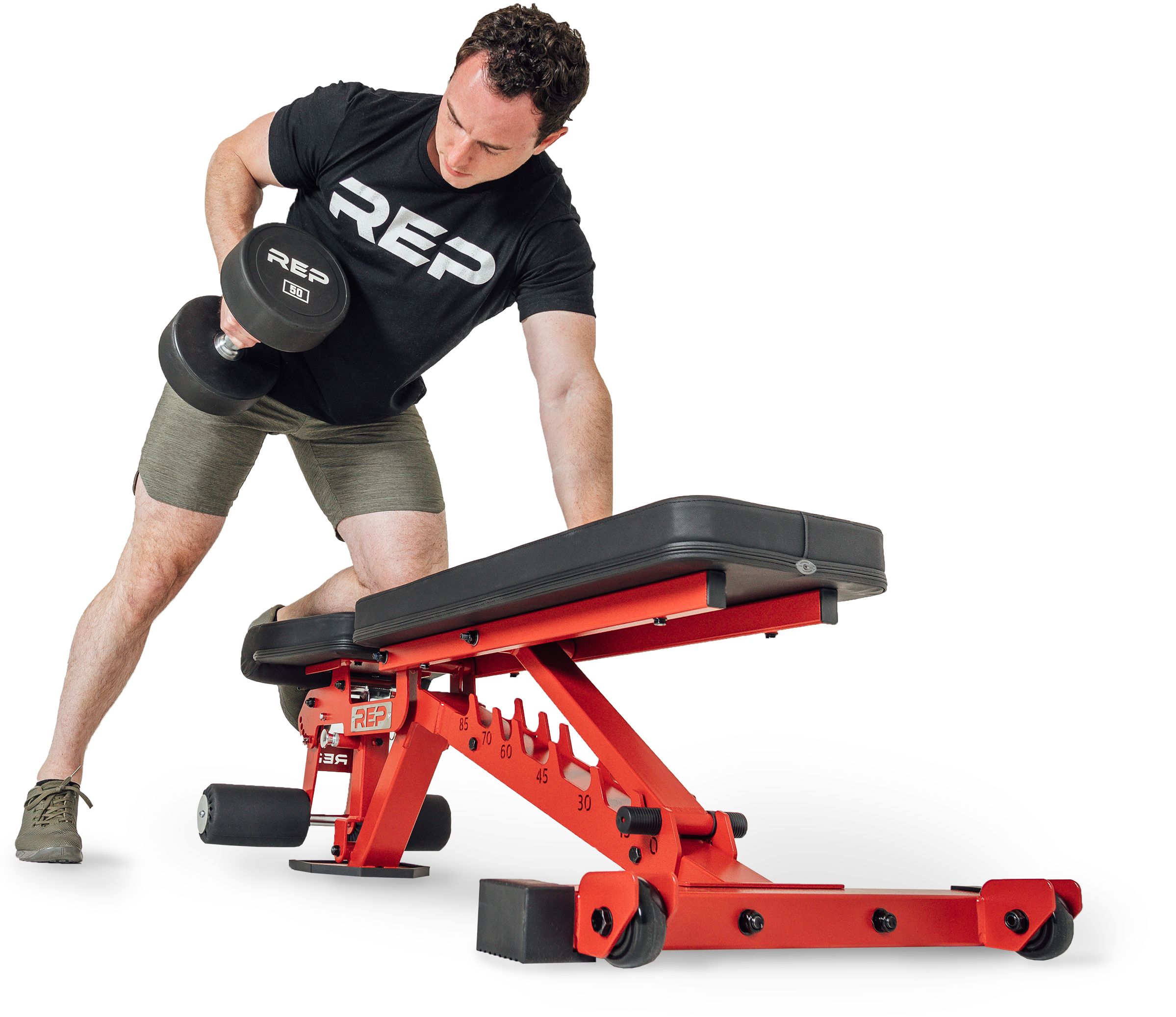
The short answer
For most home gyms, the REP Fitness AB-3000 2.0 is the best adjustable weight bench: 1,000 lb capacity, true flat-incline-decline, and in stock near $350. Drop to the Titan Performance Series or foldable Flybird to save money, or step up to the REP AB-5200 2.0 for heavy pressing and the PRx Profile to fold flat against a wall.
GearScout may earn a commission when you buy through links on this page. Prices, availability, and ratings can change, so confirm details with the retailer before purchasing.
Prices last verified July 2026.
GearScout may earn a commission when you buy through links on this page. Prices, availability, and ratings can change, so confirm details with the retailer before purchasing.
A weight bench is the cheapest way to roughly double what a home gym can train, but "adjustable bench" covers everything from a $160 fold-flat starter to a $920 wall-mounting rig, and the spec sheets bury the three things that actually decide it: whether it declines, whether the seat and back pad leave a gap under load, and how much floor it eats when you are done. This guide ranks six benches by the builder each one is for, and tells you the availability truth, because in mid-2026 a lot of the "best" benches are backordered or preorder-only.
For most home gyms the REP Fitness AB-3000 2.0 is the pick: 1,000 lb rated, true flat-incline-decline, and in stock near $350. Spend less on the Titan Performance Series or the foldable Flybird, or spend up on the REP AB-5200 2.0 if you press heavy and hate the pad gap, or the PRx Profile if you have to fold the bench against a wall.
Quick Picks
| Pick | Product | Why it fits a home gym |
|---|---|---|
| Best overall | REP Fitness AB-3000 2.0 | True flat-incline-decline, 1,000 lb, fair mid price, in stock |
| Best for heavy pressing | REP Fitness AB-5200 2.0 (ZeroGap) | Sliding seat closes the pad gap; single-hand ladder adjust |
| Most modular | Force USA MyBench | Ships with preacher-curl + leg-developer attachments (preorder) |
| Best value under $250 | Titan Performance Series | Solid flat-incline bench for the money (no decline) |
| Best budget / foldable | Flybird WB6 | Sub-$200, folds flat for a closet or apartment |
| Best wall-mount space saver | PRx Profile Incline Folding | Folds to the wall about 8 in deep; rated 1,000 lb |
Comparison Table
Prices last verified July 2026. Home-gym stock changes fast, and several benches below are backordered or preorder in mid-2026, so confirm the ship date in your cart before you buy.
| Pick | Verified price | Capacity | Decline? | Footprint / storage | Availability | Watch-out |
|---|---|---|---|---|---|---|
| REP AB-3000 2.0 | $349.99 | 1,000 lb | Yes, to -12 deg | Freestanding, wheeled | In stock, 24-48h | Two-hand pop-pin adjust |
| REP AB-5200 2.0 | $549.99 | 1,000 lb | Yes, -4/-6/-8 deg with post | Stores upright, 3.1 sq ft | Orderable, ship estimate | Pricey; heavy at 115 lb |
| Force USA MyBench | $499.00 | 705 lb tested | Yes, to -15 deg | Freestanding + attachments | Sold out, preorder | Cannot buy now |
| Titan Performance Series | $249.99 | 650 lb | No | Freestanding, 52 lb | Backorder, ~Aug 5 | No decline |
| Flybird WB6 | $159.99 | Not published | Not published | Folds flat | In stock | Light-duty; capacity not listed |
| PRx Profile Incline Folding | $922.99 | 1,000 lb | No | Wall-mount, 8 in deep stored | In stock, 2-4 wk | Needs a stud wall |
Methodology
We ranked these by what makes a bench right for a specific home-gym builder, not by a single universal "best." Four practical filters did the work: rated weight capacity versus how you will actually load it, real adjustability (does it decline, and how quick is the angle change), the seat-to-back pad gap that pinches on heavy incline, and footprint, meaning how much room the bench costs you when it is not in use.
Every price, spec, stock status, buy link, and product image was read live from each brand's own authorized product page on July 29, 2026, and each image URL was separately verified to load. DataForSEO, ScrapeBadger, and Firecrawl credentials were not available this run, so keyword volumes were not re-queried; this guide leans on public manufacturer and retailer evidence and records those limits in the research brief.
What We Checked
This is researched editorial judgment, not hands-on bench testing. We did not assemble these benches, load-test the welds, or measure wobble in a garage, so we say that plainly instead of implying a lab we did not run. What we did do is compare the official spec sheets against how each bench is actually used, and cross-check them against long-form reviews from Garage Gym Reviews and BarBend and REP's own bench-comparison guide.
What competitors miss is the boring stuff that decides whether you stay happy with a bench: the pad gap, the decline question, and honest stock. Most roundups quietly list a sold-out or preorder bench as a top pick. Here, availability rides in the table right next to the price. The Force USA MyBench is a genuinely good modular bench that you currently can only preorder, and the Titan is about a one-week backorder, and you deserve to know that before you click buy. One more honest flag: the budget Flybird's capacity is not published on its current product page, so we do not invent a number for it.
What actually matters in a home-gym bench
Lead with the takeaway, then the reason.
- Capacity is you, plus the bar, plus the plates, plus a margin. A 650 lb bench is fine for most lifters. A 1,000 lb rating is peace of mind for heavy pressers and tends to feel stiffer and last longer under abuse.
- Decline is the feature people forget they wanted. Only the two REP benches and the Force USA decline here. If you want decline presses or an anchored spot for heavy dumbbell work, that alone rules out most flat-incline benches.
- The pad gap is real. On a two-pad bench, the seat and back can leave a gap that pinches or lets you slide on steep inclines. REP's ZeroGap seat slides forward to close it; that is what the AB-5200 premium buys.
- Footprint is a spec. A freestanding bench lives on your platform forever. Upright storage (AB-5200), fold-flat (Flybird), or wall-mount (PRx) hands that floor back.
Our top picks
Best overall: REP Fitness AB-3000 2.0
The AB-3000 2.0 is the safe default for most home gyms because it does everything the expensive benches do, including true decline, at a mid price, and it is actually in stock. REP lists a 1,000 lb rating, eight back-pad angles from -12 to 85 degrees, five seat angles, 11-gauge steel, and an 89.3 lb build that stays planted under a loaded bar.
The one compromise versus REP's flagship is the two-hand pop-pin adjustment: you lift a pin and reseat it rather than sliding a single-hand ladder. For most people changing angles between sets, that is a non-issue. Pair it with a rack from our power rack guide and a set from our adjustable dumbbells guide and you have a complete pressing station.
Best for: the one bench a typical home gym should buy. Avoid if: you want single-hand angle changes or a heavier commercial build.
Best for heavy pressing: REP Fitness AB-5200 2.0 (ZeroGap)
The AB-5200 2.0 is REP's commercial-grade presser, and the reason to pay up is the patented ZeroGap seat that slides forward to eliminate the seat-to-back gap, so you do not pinch or slide on steep inclines. It uses a ladder-style adjustment you can work with one hand, unlike the two-hand pop-pin on the AB-3000, and it is rated to 1,000 lb at a hefty 115 lb.
It also stores smart, standing upright in about 3.1 sq ft, and it can decline (-4, -6, and -8 degrees) when you choose the adjustable post option. The catches are price and weight: at $549.99 and 115 lb it is an investment you will not move casually.
Best for: dedicated pressers who want zero pad gap and quick angle changes. Avoid if: you are budget-focused or do not need a commercial build.
Most modular: Force USA MyBench
The MyBench is the pick when you want a bench that doubles as an accessory station, because it ships with a preacher-curl attachment and a leg developer for seated leg extensions and prone curls. It offers seven back and three seat positions across a -15 to 80 degree range, and Force USA lists a 705 lb tested capacity, so it is a genuine three-in-one for a small setup.
The honest catch is availability: at capture it was sold out and available for preorder only, so it is a "buy when the next run lands" pick, not a today purchase. If you can wait, it packs the most training options into one footprint here.
Best for: compact gyms that want a bench plus a curl and leg station in one. Avoid if: you need a bench now, or you want the simplest possible bench.
Best value under $250: Titan Fitness Performance Series
The Titan Performance Series is the value play: a solid flat-to-incline bench with seven back angles (0 to 85 degrees), three seat angles, 2.5 in pads, and a 650 lb capacity, at $249.99 and a manageable 52 lb. The standard 17.25 in bench height keeps your press mechanics normal, and the lighter weight means you can actually reposition it.
The trade-off is that it does not decline, and its capacity is lower than the REP benches. It was also on backorder at capture, estimated to ship in early August, so confirm the date in the cart. As a straightforward flat-incline bench for the money, it is hard to beat.
Best for: a dependable flat-incline bench without paying REP or Rogue prices. Avoid if: you want decline or a 1,000 lb rating.
Best budget / foldable: Flybird (FED Fitness) WB6
The Flybird WB6, now sold under FED Fitness, is the sub-$200 starter that folds flat for a closet or an apartment corner. At $159.99 it lists an 8-by-4 set of adjustable angles and a fold-flat design, and it was in stock at capture, which is more than several pricier benches could say.
Be realistic about what an entry foldable is: its current product page does not publish a weight capacity or exact degree figures, so we do not claim one, and you should treat it as a light-to-moderate bench rather than a max-effort pressing platform. For a first bench, a small space, or a travel-light setup, it does the job for the least money.
Best for: the lowest-price or smallest-space starter that folds away. Avoid if: you plan to press heavy or want a published capacity spec.
Best wall-mount space saver: PRx Performance Profile Incline Folding
The PRx Profile is the answer when the bench has to give the floor back. It mounts to two 16 in studs, folds flat to the wall so it sticks out only about 8 in when stored, and deploys with gas-shock assistance into a full bench. Despite the folding design it is rated to a full 1,000 lb and offers 12 positions from flat to 85 degrees, and it is engineered to sit between PRx wall-mounted racks.
At $922.99 it is the priciest pick here, and it needs a solid stud wall (or a ledger board if your studs are not spaced right), so it is not for renters or non-mountable walls. But nothing else reclaims a room this cleanly. If your gym shares space with a car or a home office, this is the bench.
Best for: reclaiming floor space in a shared or small room. Avoid if: you rent, cannot mount to studs, or want a bench you can move around.
Buying Guide
Match capacity to how you load, not to the biggest number
Add your body weight, the bar, and your working plates, then leave a margin. Most lifters are well served by 650 lb; heavy pressers and anyone who wants a stiffer, buy-once feel should look at the 1,000 lb benches. Capacity is also a rough proxy for build quality and wobble.
Decide whether you need decline before you shop
Decline is the single feature that quietly eliminates benches. Only the two REP benches and the Force USA decline in this guide. If you want decline presses or a locked-in base for heavy dumbbell work, filter for it first so you do not fall for a flat-incline bench that cannot do it.
Mind the seat-to-back pad gap
Two-pad benches can leave a gap that pinches or lets you slide at steep inclines. If you press a lot of incline, a sliding-seat design like REP's ZeroGap is worth the upcharge. If you mostly train flat and low incline, a standard two-pad bench is fine.
Treat footprint and storage as a spec
A freestanding bench owns a piece of your platform permanently. If space is tight, weigh upright storage (REP AB-5200), a fold-flat frame (Flybird), or a wall-mount fold (PRx). Measure the platform first, because the bench has to coexist with a rack; see our power rack guide and round out the setup with our adjustable kettlebells guide.
Confirm stock and ship date in the cart
Home-gym benches move in and out of stock constantly. Two of the six here were backordered or preorder at capture. Prices and availability are verified as of July 2026, but always confirm the live figure and ship window before you commit.
Common mistakes
- Buying a flat-incline bench and only later realizing you wanted decline.
- Chasing a 1,000 lb rating you will never approach while ignoring a wobble or pad gap you will feel every set.
- Assuming a $160 foldable presses like a 100 lb commercial bench; match the bench to the load.
- Treating a "best bench" list as in-stock when several top benches are backordered or preorder in mid-2026.
- Forgetting the bench has to share the floor with a rack, and skipping the tape measure.
- Wall-mounting a folding bench into drywall instead of studs, or without the required ledger board.
FAQs
Do I actually need a decline bench at home?
Not everyone does, but it is the feature people most often wish they had bought. Decline lets you press at a downward angle and gives you an anchored, locked-in position for heavy dumbbell work and weighted sit-ups. Only the two REP benches and the Force USA MyBench decline in this guide, so if you want it, decide before you shop.
What weight capacity should a home-gym bench have?
Think of capacity as your body weight plus the bar plus the plates, then a safety margin. A 650 lb bench covers most lifters comfortably. Step up to a 1,000 lb rating if you press heavy or just want the extra margin and a stiffer, wobble-free feel that lasts through years of use.
Why is there a gap between the seat and the back pad?
On a two-pad adjustable bench, the seat and back are separate pieces, so at some angles they leave a gap that can pinch your back or let you slide down on steep inclines. Benches like the REP AB-5200 use a seat that slides forward to close the gap, which is a big part of what the premium price buys.
Is a foldable weight bench strong enough?
Good fold-flat and wall-mount benches can be plenty strong; the PRx Profile is rated to 1,000 lb. Very cheap foldables are a different story and are better treated as light-to-moderate benches. The budget Flybird here does not publish a capacity figure on its current product page, so treat it accordingly and do not load it like a commercial bench.
Adjustable bench or flat bench for a home gym?
If you only ever flat-bench and want the lowest, stiffest, cheapest platform, a dedicated flat bench wins. For almost everyone else an adjustable bench is the better single purchase because incline and decline unlock a lot more exercises for a small price and space premium. Most home gyms should buy one good adjustable bench.
How much should I spend on an adjustable weight bench?
Expect roughly $150 to $350 for a solid home bench, and $500 to $950 for a commercial-grade or space-saving design. The $350 REP AB-3000 2.0 is the value sweet spot for most people. Below about $200 you are buying a light-duty or foldable bench, which is fine if you match it to a lighter load.
Common questions
Frequently asked questions
- Do I actually need a decline bench at home?
- Not everyone does, but it is the feature people most often wish they had bought. Decline lets you press at a downward angle and gives you an anchored, locked-in position for heavy dumbbell work and weighted sit-ups. Only the two REP benches and the Force USA MyBench decline in this guide, so if you want it, decide before you shop.
- What weight capacity should a home-gym bench have?
- Think of capacity as your body weight plus the bar plus the plates, then a safety margin. A 650 lb bench covers most lifters comfortably. Step up to a 1,000 lb rating if you press heavy or just want the extra margin and a stiffer, wobble-free feel that lasts through years of use.
- Why is there a gap between the seat and the back pad?
- On a two-pad adjustable bench, the seat and back are separate pieces, so at some angles they leave a gap that can pinch your back or let you slide down on steep inclines. Benches like the REP AB-5200 use a seat that slides forward to close the gap, which is a big part of what the premium price buys.
- Is a foldable weight bench strong enough?
- Good fold-flat and wall-mount benches can be plenty strong; the PRx Profile is rated to 1,000 lb. Very cheap foldables are a different story and are better treated as light-to-moderate benches. The budget Flybird here does not publish a capacity figure on its current product page, so treat it accordingly and do not load it like a commercial bench.
- Adjustable bench or flat bench for a home gym?
- If you only ever flat-bench and want the lowest, stiffest, cheapest platform, a dedicated flat bench wins. For almost everyone else an adjustable bench is the better single purchase because incline and decline unlock a lot more exercises for a small price and space premium. Most home gyms should buy one good adjustable bench.
- How much should I spend on an adjustable weight bench?
- Expect roughly $150 to $350 for a solid home bench, and $500 to $950 for a commercial-grade or space-saving design. The $350 REP AB-3000 2.0 is the value sweet spot for most people. Below about $200 you are buying a light-duty or foldable bench, which is fine if you match it to a lighter load.
References
Sources
- REP Fitness AB-3000 2.0 FID Adjustable Bench official product page
- REP Fitness AB-5200 2.0 Adjustable Bench official product page
- REP Fitness adjustable bench comparison guide
- Force USA MyBench official product page
- Titan Fitness Performance Series Adjustable Bench official product page
- FED Fitness (Flybird) Series WB6 Foldable Adjustable Bench official product page
- PRx Performance Profile Incline Folding Weight Bench official product page
- Garage Gym Reviews: REP Fitness AB-5200 Adjustable Bench review
- BarBend: Force USA MyBench FID review
Keep reading
Related guides
Best Power Racks for Garage Gyms (2026)
Compare garage-friendly power racks by footprint, height, price, no-bolt setup, folding clearance, and attachment ecosystem.
May 29, 2026

Best adjustable dumbbells for a home gym (2026)
The best adjustable dumbbells for home gyms, with picks for beginners, heavy lifting, durability, and small spaces.
May 29, 2026

Best adjustable kettlebells for home gym (2026): 6 picks by adjustment mechanism and weight range
The best adjustable kettlebells for a home gym in 2026, ranked by adjustment mechanism, weight range, and price, from the BowFlex 840 to the PowerBlock Pro.
Jul 28, 2026

Best weighted vest for women (2026): ranked by smallest weight step, not max load
Nine women's and unisex weighted vests compared on smallest published weight step, size-chart disclosure, and cost per pound of load. Verified Aug 2026.
Aug 31, 2026