The short answer
On clay, only a full-herringbone outsole grips and sheds grit — which rules out almost every hard-court shoe. Best all-round: adidas Barricade 14 Clay ($127.95), also the deepest-stocked. Cheapest full size run: K-Swiss Hypercourt Express 3 Clay, $97.50. Wide feet: New Balance CT Rally 2 Clay 2E, the only 2E on the shelf.
GearScout may earn a commission when you buy through links on this page. Prices, availability, and ratings can change, so confirm details with the retailer before purchasing.
Prices last verified August 2026.
You joined a clay league, played one set in the shoes you already own, and spent it sliding when you meant to stop and stopping when you meant to slide. That is not technique. That is the wrong outsole.
Clay is the one surface in tennis that genuinely disqualifies most of the category. Every "best tennis shoes" list you have already read optimises for abrasion resistance on concrete, because that is where most tennis is played and where outsoles die. On clay, abrasion is not the problem — grip and grit evacuation are. So this guide starts with the constraint, ranks by how well each shoe answers it, and tells you the two things the other clay guides leave out: what you give up when you buy the clay version, and whether the shoe actually exists in your size.
Seven picks, $97.50 to $159.95, all verified against live retailer pages on 6 August 2026.
The clay filter: what this rules out
Before any picks, here is what the surface eliminates and why.
The outsole must be full-coverage herringbone. This is the hard filter, and it is not marketing. A clay outsole is a tight, uninterrupted zig-zag pattern spanning the whole contact area, with channels that push grit sideways and out as the foot loads. Every shoe in this guide was confirmed as full or sharp herringbone from the retailer's own spec copy.
- Eliminates hard-court and all-court outsoles, which mix herringbone with pivot circles, smooth panels or modified heel patterns. Those patterns trap clay instead of shedding it, and a packed sole is a smooth sole.
- Eliminates running shoes and cross-trainers outright. Lug and waffle patterns dig into a clay surface rather than sliding across it, which is bad for the court and worse for your ankles.
- Does not eliminate any particular brand. Every major maker sells a clay SKU. They are simply a fraction of the models on the shelf.
The shoe must be sold as a clay SKU, not a colourway. Clay models carry a separate product code from their hard-court siblings — the ASICS Gel-Resolution X Clay is a different product from the Gel-Resolution X, not a different colour of it.
- Eliminates the assumption that you can order your usual model and be fine.
- Costs you the outsole durability guarantee. This is the finding this guide is built around, and it is covered in full below.
Your size has to exist. This is the constraint nobody writes about, and on the US clay shelf it decides more purchases than any spec.
- Eliminates, in practice, several otherwise excellent shoes. Two of the seven picks below are down to one or two pairs per size.
- Does not eliminate the deep-stocked picks — one model here is carried in fourteen sizes with four or more pairs in nearly all of them.
A wide foot narrows this to one shoe. Court shoes are built snug because lateral support depends on a close fit, and clay ranges are the smallest ranges brands make. Going through all of the roughly 55 men's clay listings live in August 2026, exactly one came in a wide width.
Why the shoes on every "best tennis shoe" list fail here
Two specific failures worth naming.
The ASICS Gel-Resolution X is the most recommended tennis shoe on the internet, and the version people link to is the wrong one. The standard Gel-Resolution X is an outstanding hard-court shoe — it is the top pick in our own hard-court guide, partly because it carries a 6-month outsole durability guarantee. Buy that shoe for clay and you get an all-court tread that loads up with grit, and you have paid a premium for abrasion resistance that clay will never test. The Gel-Resolution X Clay is a separate product with a full-herringbone AHAR Plus outsole. It is in this guide. The one everybody links to is not.
The other failure is staleness. Checking the guides currently ranking for this query, the picks include the ASICS Gel-Resolution 9 Clay, the Babolat Jet Mach 3 Clay, the Nike Vapor 11 and the long-discontinued Nike Court Vapor X Clay. The current US shelf is the Gel-Resolution X, the Jet Mach 4, and the Vapor Pro 3. Several of those guides also price in euros and recommend models US buyers cannot get. If a clay guide does not tell you what is in stock this month, it is describing a shelf that no longer exists.
Quick Picks (clay-first)
Ranked by how well each shoe answers the clay constraint — outsole, then buyable size availability — with general quality second.
| Best for | Pick | Price | Why it wins on clay |
|---|---|---|---|
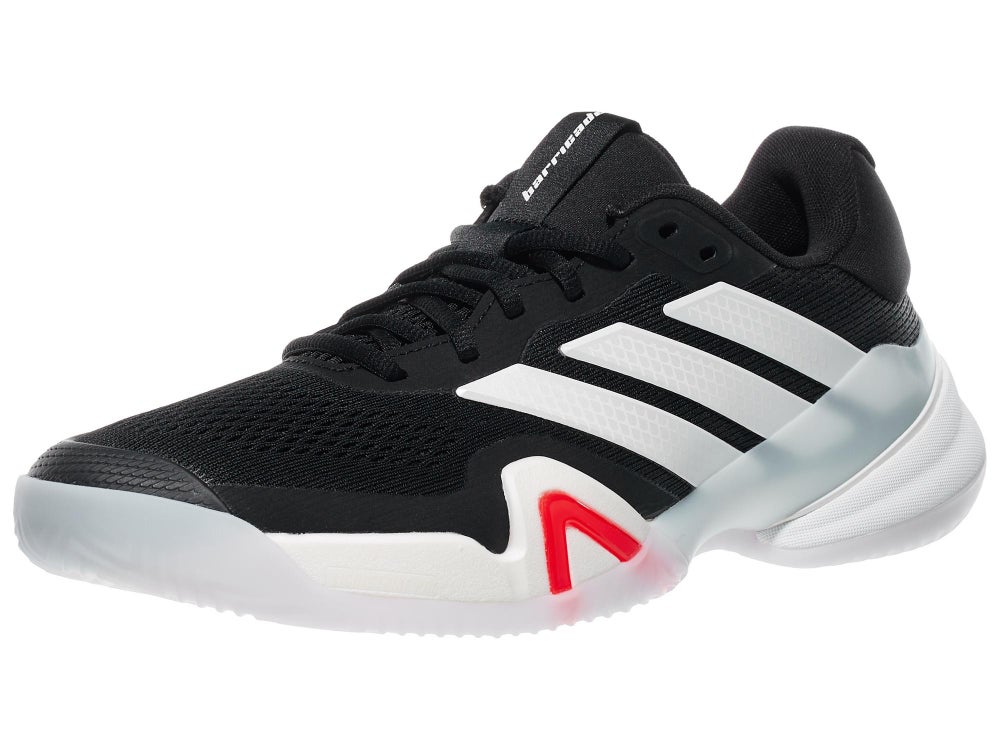
| Best overall (and safest to actually order) | adidas Barricade 14 Clay | $127.95 | Full-herringbone Lighttraxion outsole, genuine max-stability chassis, and by far the deepest stock: sizes 6.5-13.0 with 4+ pairs in nearly all |
| Cheapest full size run | K-Swiss Hypercourt Express 3 Clay | $97.50 | The lowest price on the shelf that still comes in 7.0-13.0, in the roomiest fit of the seven |
| Best value with every size in stock | Nike Vapor Pro 3 Clay | $108.00 | Claybreaker sharp-herringbone tread in Hart rubber, and the only sub-$110 pick with all twelve sizes available |
| Best for wide feet | New Balance CT Rally 2 Clay 2E | $149.99 | The only 2E width in the entire men's clay category, in sizes 7.0-14.0 |
| Best for sliding (lightest) | Babolat Jet Mach 4 Clay | $159.00 | 13.7 oz with a Michelin full-herringbone outsole and an abrasion-resistant Matryx EVO upper |
| Most supportive | ASICS Gel-Resolution X Clay | $159.95 | The most locked-down frame here; the 16.1 oz weight is the support, not padding |
| ASICS fit on a budget | ASICS Gel-Challenger 15 Clay | $119.95 | Rearfoot GEL and AHARPLUS herringbone $40 under the Gel-Resolution X Clay — if your size is among the seven left |
Comparison Table
Prices last verified August 2026. Clay-constraint columns come first, because on this surface they decide the purchase before weight or price does.
| Pick | Clay outsole | Sizes in stock (6 Aug) | Width | Weight | Price | Best for | Avoid if |
|---|---|---|---|---|---|---|---|
| adidas Barricade 14 Clay | Lighttraxion, full herringbone | 6.5-13.0, mostly 4+ pairs | D | 14.1 oz | $127.95 | Heavy movers, aggressive sliders | You want a light or narrow shoe |
| Nike Vapor Pro 3 Clay | Claybreaker sharp herringbone, Hart rubber | 7.0-13.0, all in stock | D | 15.0 oz | $108.00 | Value buyers who want a certain fit | You need maximum lateral support |
| K-Swiss Hypercourt Express 3 Clay | Aosta 7.0, full herringbone | 7.0-13.0; four sizes on 08/14 restock | D | 15.1 oz | $97.50 | The cheapest way onto clay; roomy feet | You need 9.0-11.0 this week |
| New Balance CT Rally 2 Clay 2E | NDurance, full herringbone | 7.0-14.0 | 2E wide | 15.8 oz | $149.99 | Wide feet — the only option | You have narrow feet or want light |
| Babolat Jet Mach 4 Clay | Michelin, full herringbone | 7.5-12.5 | D | 13.7 oz | $159.00 | Sliding, speed, court feel | You need a 13.0 or want cushioning |
| ASICS Gel-Resolution X Clay | AHAR Plus, full herringbone | 6.5, 8.5-11.5; several single pairs | D | 16.1 oz | $159.95 | Long matches, heavy lateral load | You want a light shoe |
| ASICS Gel-Challenger 15 Clay | AHARPLUS, full herringbone | 7 sizes, 1-2 pairs each | D | 14.6 oz | $119.95 | ASICS fit without Gel-Resolution money | Your size is not among the seven |
Outsole durability guarantee: none of the above. All seven show no retailer outsole guarantee. See the next section for what that does and does not mean.
Methodology
The ranking is constraint-first, in this order:
- Outsole geometry (pass or fail). Full or sharp herringbone across the whole contact area, confirmed from the retailer's spec copy for each model. Anything else was not considered, regardless of quality.
- Buyable size availability (the tie-breaker that moved shoes up and down). We read the live size selector on each product page and recorded per-size pair counts. A shoe carried in fourteen sizes with four or more pairs each is a materially better recommendation than an equally good shoe down to one pair in eight sizes, and we ranked accordingly. This is why the Barricade 14 Clay finished above two more expensive shoes.
- Width availability. Checked across the full men's clay category, not just the picks, because a 2E buyer needs a complete answer.
- Weight and platform. Used to separate the picks by playing style once they had cleared the constraint — the range here is 13.7 oz to 16.1 oz at size 10.5, and that 2.4 oz spread is the difference between a sliding shoe and a support shoe.
- Price, last. Deliberately last. On a shelf this thin, the cheapest shoe that fits and is in stock beats the better shoe that is not.
What we did not do: rank by outsole compound. Aosta 7.0, Hart, AHARPLUS, Lighttraxion, NDurance, Michelin and AHAR Plus are manufacturer names quoted from spec copy, and we have no independent wear-rate data comparing them on clay. We report the compound and let it inform the description; we do not pretend it produced the ordering.
What We Checked
We have not played a point on clay in any of these shoes. GearScout ran no on-court testing for this guide, and nothing below is a hands-on impression. What we did instead was verify, on 6 August 2026, every fact that a buyer would otherwise have to take on trust — and two of those checks turned up things no competing guide reports.
We compared the clay and hard-court versions of the same shoes, and the guarantee does not carry over. We pulled the raw page source for each clay model and searched for the retailer's outsole durability guarantee badge, then did the same for the hard-court siblings. The result: zero of the seven clay models carry it. The hard-court ASICS Gel-Resolution X and the hard-court adidas Barricade 14 both do.
The honest version of that finding needs one qualification, because we checked a third pair too: the hard-court K-Swiss Hypercourt Express 3 does not carry the guarantee either. So the guarantee is awarded per model, not automatically to every hard-court shoe. What is true, and what we measured, is that on the clay shelf the count was zero out of seven — and that two shoes which are covered on concrete lose that cover when you buy the clay version. Worth knowing before you assume your usual model protects you. Two of the clay pages do contain the phrase "6 month sole guarantee", but in both cases it sits inside customer review text, not the retailer's badge, so we did not count it.
In practice this matters less than it sounds, and we would rather say so than oversell our own finding: clay barely abrades an outsole, so tread wear is rarely what kills a clay shoe. The uppers and drag-zone reinforcements usually go first. The point is not that you are being short-changed — it is that the durability premium you pay for on a hard-court shoe buys you nothing here, which should change which shoe you pick.
We counted the stock, size by size. Rather than reporting "in stock", we recorded per-size pair counts from every live size selector. The spread is wider than the price range suggests: the Barricade 14 Clay is carried in fourteen sizes with four or more pairs in nearly all of them, while the Gel-Challenger 15 Clay — $8 cheaper — is down to seven sizes at one or two pairs each, and the Gel-Resolution X Clay has several sizes at a single pair. There is also a $89.94 clearance colourway of the Nike Vapor Pro 3 Clay that looks like the bargain of the shelf until you see that two of its six sizes are already sold out. We ranked on this, and we listed the counts in the table so you can check them against what you see when you click through.
We went through the whole category for the width question. All of the roughly 55 men's clay listings, not just our picks. One 2E: the New Balance CT Rally 2 Clay.
Everything else was verified mechanically. All seven prices were read from each product page's structured price data rather than the rendered page, all seven product images returned HTTP 200 with an image content type, and all buy links were confirmed live with a full GET request. Discounts are the one soft spot: the "reduced from $169.95" and "$130.00 list" figures come from the category page's client-rendered markup, which is a weaker source than the structured price data, so treat current prices as solid and the size of the discount as indicative.
Scope limits, stated plainly. Every pick is a men's SKU from a single authorised specialist retailer. Women's clay equivalents exist for most of these models and were not verified this run. Per-size stock on a shelf this thin moves within days.
The picks in detail
adidas Barricade 14 Clay — $127.95 — best overall
Best for: heavier movers, aggressive sliders, and anyone who wants to be certain their size is actually there. Avoid if: you want a light shoe or a narrow fit.
The Barricade has been the stability benchmark in tennis for two decades, and the 14 is the lightest genuinely supportive version of it — 14.1 oz on a dual-density midsole, Repetitor in the heel for control and Lightstrike Pro in the forefoot for push-off, wrapped on a chassis with the Barricade claw. The upper is engineered mesh with ADITUFF over the drag zones, which is the part that matters on clay, where the medial forefoot takes the abrasion.
It wins here on availability as much as on merit. Sizes 6.5 through 13.0, nearly all showing four or more pairs — the only shoe on this shelf you can recommend to a stranger without asking their size first. At $127.95 down from $169.95 it also undercuts both $159 picks.
The catch, and it is the one to internalise: the hard-court Barricade 14 carries the 6-month outsole guarantee. This one does not.
Nike Vapor Pro 3 Clay — $108.00 — best value
Best for: buyers who want a fast, low-slung shoe under $110 and a size that is definitely in stock. Avoid if: you need maximum lateral lockdown.
Nike's Claybreaker tread is a sharp herringbone rather than the softer full pattern used by ASICS and adidas, and it is moulded in Hart rubber, which also appears on the toe-tip and eyestay — the two places a clay player wears through first if they drag. A hex Zoom Air unit sits in the forefoot, and the lateral TPU has a deeper flex groove than the previous version for easier push-off.
Every size from 7.0 to 13.0 was in stock, which no other sub-$110 pick manages. Note the alternative: a Blue/Navy clearance colourway of the identical shoe sits at $89.94, but with two sizes already sold out and one to four pairs across the rest, it is a coin flip on fit. Eighteen dollars is cheap insurance.
K-Swiss Hypercourt Express 3 Clay — $97.50 — cheapest full size run
Best for: the cheapest way onto clay in a shoe that comes in your size, and players who find ASICS and Nike lasts tight. Avoid if: you need a 9.0 to 11.0 immediately, or you want something light.
The cheapest shoe here that is still carried across a full 7.0-13.0 run. Non-marking Aosta 7.0 rubber in full herringbone, a Surgelite+ midsole, and a mid-foot 180 Plantar Support Chassis that does more for lateral stability than the price suggests. The seamless synthetic and mesh upper with DuraWrap is the roomiest fit of the seven — the reason to pick it if court shoes usually pinch you.
At 15.1 oz it is not a fast shoe, and four sizes (9.0, 9.5, 10.5, 11.0) currently show an 08/14 restock date rather than immediate stock. If yours is one of those, the Nike at $108 is the better order.
New Balance CT Rally 2 Clay 2E — $149.99 — best for wide feet
Best for: wide feet. On this shelf it is not the best answer, it is the only one. Avoid if: you have narrow feet, or you want a light shoe.
We went through the whole men's clay category to check this, and one shoe came back in a wide width. NDurance rubber in full herringbone, a Fresh Foam X midsole, an NDure upper with FantomFit, and an external heel frame — a properly built court shoe rather than a token wide SKU. Sizes 7.0 to 14.0 in 2E, including a 14.0, which almost nothing else on the shelf offers in any width. The same shoe is sold in standard D as a separate listing at the same $149.99.
At 15.8 oz it is the second-heaviest pick, and you are paying $150 with limited leverage to negotiate. That is what a monopoly looks like.
Babolat Jet Mach 4 Clay — $159.00 — best for sliding
Best for: players who slide into shots and want the most connected feel on court. Avoid if: you need a 13.0, or you want cushioning.
At 13.7 oz this is the lightest shoe here by nearly half an ounce, and it feels like it. The outsole is Michelin rubber in full herringbone — the one compound in this line-up with a reputation earned outside tennis. The upper is dual-layer Matryx EVO with aramid and high-strength polyamide fibres, which is a genuinely good answer to clay grit abrasion, and the EVA midsole runs a Starting Bloc plate for lateral stability so the low weight does not cost you the edge of the shoe.
The practical limitation is the size run: 7.5 to 12.5, with no 13.0 offered at all.
ASICS Gel-Resolution X Clay — $159.95 — most supportive
Best for: long matches, heavy lateral load, players who want the most locked-down frame on clay. Avoid if: you want a light shoe, or your size is not among the eight listed.
The flagship. AHAR Plus in full herringbone, FlyteFoam Blast+ and ECO Foam with GEL, DYNALACING, and the Flexion Fit upper. At 16.1 oz it is the heaviest shoe in this guide, and that is the trade being offered: this is the most supportive platform here, and the weight is the structure delivering it rather than padding.
Buy it for three-set matches on a hot afternoon. Two caveats. The stock is thin — eight sizes, several down to a single pair — and this Grey/Pistachio is the cheapest current listing at $159.95, with two other colourways at $164.95. And as with the Barricade, the hard-court version of this exact shoe carries the outsole guarantee. This one does not.
ASICS Gel-Challenger 15 Clay — $119.95 — ASICS fit on a budget
Best for: players who want ASICS fit and rearfoot GEL without Gel-Resolution money. Avoid if: your size is not one of the seven left, which is a real risk.
Good shoe, awkward recommendation. AHARPLUS in full herringbone, rearfoot GEL, a Wingwall for lateral stability, and a perforated synthetic upper with Pguard drag protection across the toe and medial forefoot. At 14.6 oz it is lighter than the Gel-Resolution X Clay and $40 cheaper, which is a legitimately attractive combination if the ASICS last suits you.
It places last here purely on the constraint that matters most: seven sizes, one or two pairs each. The White/Cherry colourway is the same price with the same thin depth. If your size is there, it is arguably better value than anything above it. If it is not, nothing else about the shoe helps you.
Buying Guide
Start with your size, not the reviews. This is the inversion clay forces on you. On a hard-court shelf you pick the shoe and then find the size. Here, two of seven picks are down to one or two pairs and one has sizes already sold out, so open the size selector first and let it eliminate. A very good shoe you cannot buy is worth less than a good shoe you can.
Then pick your side of the weight split. The seven picks span 13.7 oz to 16.1 oz, and that gap is the real fork in this category. Under about 14.5 oz — the Babolat Jet Mach 4 Clay, the adidas Barricade 14 Clay — you get court feel and easy sliding. Over about 15 oz — the ASICS Gel-Resolution X Clay, the New Balance CT Rally 2 Clay — you get a frame that holds up under repeated hard lateral loading in a long match. Neither is better. They answer different questions about how much support your ankles want.
Do not pay a durability premium on clay. Hard-court pricing is partly a bet on abrasion resistance, and on clay that bet does not pay. None of these seven carry an outsole guarantee, and clay will not grind the tread flat anyway. Spend the budget on fit and support instead, which is why the $127.95 Barricade outranks two $159 shoes here.
If you need a wide, your decision is already made. One 2E exists. Buy it or accept a snug fit.
Keep the shoes surface-specific. A clay outsole on concrete is a fast way to sand off a soft, tightly spaced tread that has no warranty behind it. If you split time between surfaces, the honest answer is two pairs — see our hard-court guide for that half of the decision, where the durability guarantee genuinely is worth ranking by.
One more thing to budget for. Clay chews through the rest of your kit faster than it does your shoes — grit gets everywhere, and your string and grip life will tell you about it before your outsole does. If you are upgrading the whole setup, our intermediate racket guide covers the frame side, and beginner rackets if you are earlier than that. The full racket-sports hub has the rest.
Common mistakes on clay
- Ordering your usual model and assuming it is the clay one. The clay version has a different product code and a different outsole. Colour is not the difference.
- Buying the clearance colourway without opening the size selector. The $89.94 Nike looks like the smart buy until two of its six sizes turn out to be gone.
- Paying up for outsole durability you will never use. Clay is not what wears a tread out. The premium is real on concrete and pointless here.
- Assuming a hard-court shoe is fine because you are only playing socially. It is not a durability question, it is a grip question — and many clay clubs ask for a clay-specific non-marking outsole to protect the surface. Check before you turn up.
- Wearing the clay pair on hard courts between clay matches. The fastest way to ruin a $159 shoe that has no warranty.
- Waiting for a restock in your size. On a shelf where several models carry one pair per size, the pick that is in stock today is usually the better decision than the pick you wanted.
- Ignoring width because you always have. If court shoes hurt you and you have never looked, there is exactly one 2E clay option and it is worth trying.
FAQs
Common questions
Frequently asked questions
- Can I just wear my hard-court tennis shoes on clay?
- You can, but you give up grip and you may not be welcome. Hard-court outsoles use modified or mixed tread patterns optimised for abrasion resistance on concrete. On clay those patterns pack with grit instead of shedding it, so the shoe skates instead of biting. Many clay clubs also ask for non-marking clay-specific outsoles to protect the surface. Check your club's rule before you play.
- Can I wear clay shoes on a hard court?
- It works, but it is an expensive way to play. A clay outsole is a soft, tightly spaced full-herringbone pattern designed for a forgiving surface. Concrete grinds those thin ridges flat quickly, and unlike the hard-court versions of these same shoes, none of the seven clay models here carry an outsole durability guarantee. Keep clay shoes for clay.
- Why do clay versions not carry the 6-month outsole guarantee?
- We checked this directly rather than assuming. Across the seven clay models in this guide, none carried Tennis Warehouse's 6-month outsole durability guarantee badge, while the hard-court versions of the ASICS Gel-Resolution X and the adidas Barricade 14 both did. The guarantee is awarded per model, not per surface — the K-Swiss hard-court model does not carry it either — but on the clay shelf the count was zero out of seven.
- How do I tell a genuine clay outsole from a marketing label?
- Turn the shoe over. A clay outsole is full-coverage herringbone: tight, uninterrupted zig-zag ridges running across the whole contact area, with channels that push grit out sideways as you move. If the sole mixes herringbone with pivot circles, smooth panels or a modified heel pattern, it is a hard-court or all-court sole. Every pick in this guide was confirmed as full or sharp herringbone from the retailer's own spec copy.
- Are any clay tennis shoes made in a wide width?
- Almost none. We went through all of the roughly 55 men's clay listings live on Tennis Warehouse in August 2026 and found exactly one wide option: the New Balance CT Rally 2 Clay in 2E at $149.99, offered in sizes 7.0 to 14.0. The same shoe is sold separately in standard D width. If you need a 2E, that is the shelf.
- How long should a clay shoe last?
- Longer than a hard-court shoe on the outsole, and that is the point. Clay is far less abrasive than concrete, so the tread is rarely what fails first — the upper, the midsole or the drag-zone reinforcement usually goes before the herringbone wears smooth. That is also the practical reason the durability guarantee is beside the point on clay. We have no independent wear-rate data for these specific models and have not tested them, so treat that as reasoning rather than a measurement.
- Do these come in women's sizes?
- Most of these models have women's clay equivalents at the same retailer, but this guide is scoped to men's SKUs. Every price, weight, per-size stock count and image here was verified against a men's product page in August 2026. We did not verify the women's versions this run, so treat the women's line-up as unchecked rather than endorsed.
References
Sources
- Tennis Warehouse — Clay Court Men's Shoes category (live lineup and pricing)
- Tennis Warehouse — K-Swiss Hypercourt Express 3 Clay Blue/Black
- Tennis Warehouse — Nike Vapor Pro 3 Clay Black/White
- Tennis Warehouse — ASICS Gel-Challenger 15 Clay Oat/Night
- Tennis Warehouse — adidas Barricade 14 Clay Black/White/Red
- Tennis Warehouse — New Balance CT Rally 2 2E Clay Medusa Green
- Tennis Warehouse — Babolat Jet Mach 4 Clay Black/Aero
- Tennis Warehouse — ASICS Gel-Resolution X Clay Grey/Pistachio
- Tennis Warehouse — ASICS Gel-Resolution X (hard court, guarantee comparison)
- Tennis Warehouse — adidas Barricade 14 (hard court, guarantee comparison)
Keep reading
Related guides
Best Tennis Shoes for Hard Courts (2026): 6 Durable Picks by Outsole Warranty
The best tennis shoes for hard courts in 2026, ranked by outsole durability and the 6-month wear-through warranty — from $79 to $170.
Jul 29, 2026
Best Tennis Rackets for Intermediate Players (2026): 7 Picks by Play Style
The best intermediate tennis rackets for 2026, ranked by play style — spin, power, control, comfort — with a $259 value pick and the best all-court overall.
Jul 31, 2026
Best Tennis Rackets for Beginners: Picks by Buyer Type (2026)
The best beginner tennis rackets by buyer type: a $30 first frame, the $99 value champ, and arm-friendly picks you'll grow into — plus what to skip.
Jul 29, 2026
Best Pickleball Paddles for Intermediate Players (2026): 6 Picks by Play Style
The best intermediate pickleball paddles for 2026 — raw-carbon all-court picks ranked by budget and play style, from a $70 steal to premium power.
Aug 2, 2026