The short answer
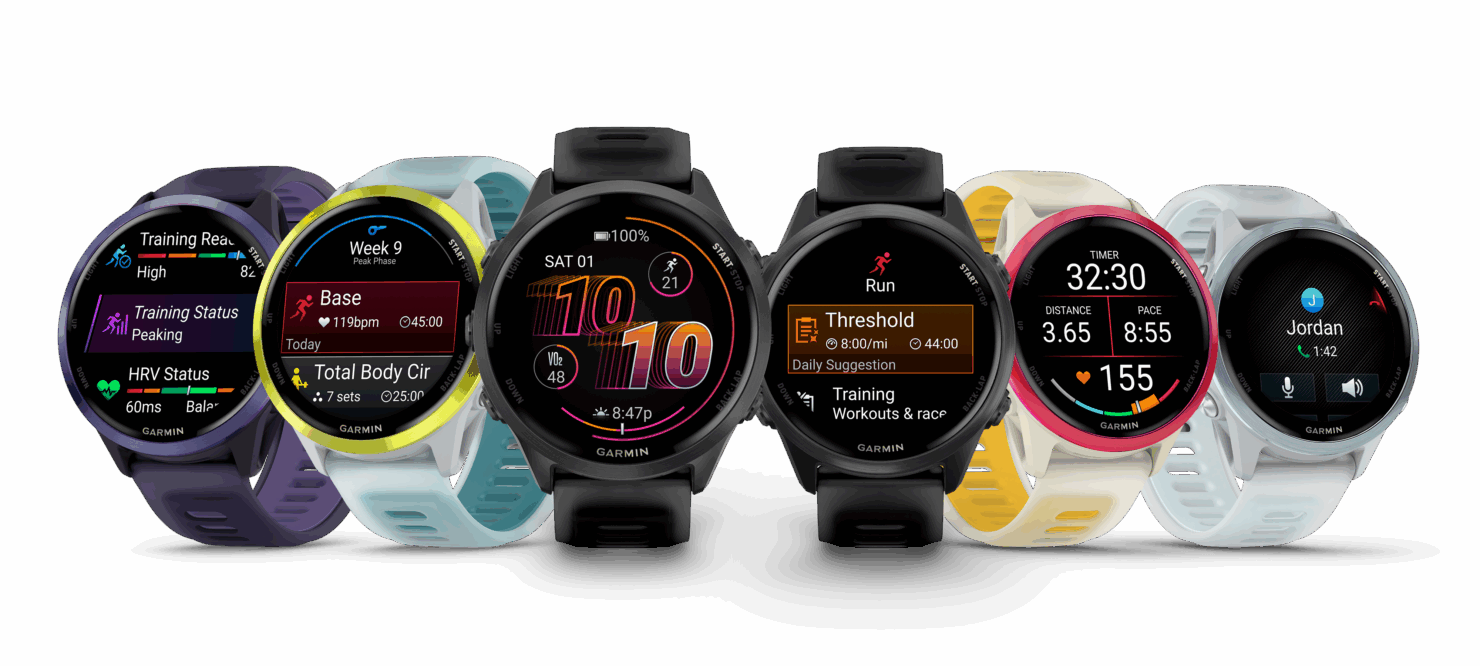
For most marathoners, the Garmin Forerunner 570 is the best all-around GPS watch: AMOLED, deep training tools, and easily enough battery for a marathon. On a budget, the COROS Pace 4 ($249) is the smart pick — featherweight with 41 hours of GPS. Want maps or a smartwatch? The Forerunner 970 or Apple Watch Ultra 3.
GearScout may earn a commission when you buy through links on this page. Prices, availability, and ratings can change, so confirm details with the retailer before purchasing.
Prices last verified July 2026.
A marathon block is where a running watch earns its price. You will wear it for 12 to 20 weeks of structured workouts, long runs, and easy recovery miles, then ask it to pace you through 26.2. This guide ranks seven GPS watches from $249 to $799 by the things that actually matter in a marathon build: GPS battery you will not have to babysit, a real structured-workout and adaptive-plan engine, weight on a three-hour long run, and race-day pacing tools.
Every price, spec, and image here was verified on July 28, 2026 against the manufacturer or an authorized retailer. The good news up front: every watch on this list has more than enough battery to record a single marathon, so the real question is which one fits your budget, your training platform, and how much you care about maps, weight, and smartwatch features. Where a number is the manufacturer's spec rather than something we measured, we say so.
Quick Picks
| Best for | Pick | Why it wins |
|---|---|---|
| Best overall for most marathoners | Garmin Forerunner 570 | Full Garmin training stack, AMOLED, race-day pacing — the complete package |
| Best value | COROS Pace 4 | 32g, 41 GPS hours, AMOLED — most watch per dollar at $249 |
| Best budget | Garmin Forerunner 165 | Cheapest Garmin AMOLED with real adaptive marathon plans |
| Best maps for less | Suunto Race S | Offline maps and long battery at a midrange price |
| Best for recovery data | Polar Vantage V3 | Deepest recovery and training-load tools on the wrist |
| Best premium (maps + everything) | Garmin Forerunner 970 | Full-color onboard maps, titanium and sapphire, top training stack |
| Best smartwatch for iPhone runners | Apple Watch Ultra 3 | One durable device for training and everyday iPhone life |
Comparison Table
Prices last verified July 2026. Garmin and Apple street prices move often, so confirm the live price at the retailer before you buy.
| Watch | Price | GPS battery | Onboard maps | Best for | Watch-out |
|---|---|---|---|---|---|
| Garmin Forerunner 165 | $249.99 | 19 hr | No (breadcrumb) | Budget Garmin ecosystem | No dual-band GPS |
| COROS Pace 4 | $249 | 41 hr | Breadcrumb | Value + battery, 32g | Lighter app ecosystem |
| Garmin Forerunner 570 | $549.99 | 18 hr | No | All-around Garmin training | Shortest GPS battery here; no maps |
| Suunto Race S | $269 (sale; reg $339) | 40 hr | Yes (offline) | Maps for less | Sale price; smaller ecosystem |
| Polar Vantage V3 | $699.99 | up to 47–61 hr | Yes (offline) | Recovery + training load | Premium price; niche appeal |
| Garmin Forerunner 970 | $749.99 | 26 hr | Yes (full color) | Premium maps + full stack | Overkill for a first marathon |
| Apple Watch Ultra 3 | $799 | 14 hr (full GPS) | Via iPhone | One device for iPhone runners | Daily charging in heavy blocks |
Battery figures are each maker's stated GPS-workout numbers (Apple's is its "full GPS and heart rate" figure). Polar and Suunto quote higher all-systems numbers that fall in dual-frequency mode; real-world recording usually lands below the headline.
Methodology
We ranked these seven watches for marathon training specifically, not for general smartwatch use. Four things drove the order: GPS-workout battery across a full training block (not just race day), the depth of the structured-workout and adaptive-plan engine, weight and comfort on long runs, and race-day pacing tools. Price and value were weighted for a runner training for a marathon, from a first-timer to a sub-3 chaser.
We checked every manufacturer or authorized-retailer page on July 28, 2026 for current price, availability, key specs, and a live product image, and we confirmed each image link returned an official brand or authorized-retailer asset (HTTP 200). Where a figure is the maker's spec — like battery hours or weight — we treat it as a claim, not a measurement.
What We Checked
What competitors miss is that battery is almost never the limiter for a single marathon. Every watch here will record all 26.2 miles with room to spare, so "lasts the race" is table stakes, not a selling point. The marathon-training constraints that actually separate these watches are the ones most lists bury:
- Battery across a block, not a race. With an always-on AMOLED and daily long runs, the gap between the 41-hour COROS Pace 4 and the 14-hour (full-GPS) Apple Watch Ultra 3 is the difference between charging every couple of weeks and charging most nights. Notably, the $549.99 Forerunner 570 posts just 18 GPS hours — the shortest here, and less than the $249 picks — because AMOLED and features cost battery.
- A real training engine, not just recording. Garmin Coach and COROS Training Hub build and adapt a plan around your fitness. A watch that only records pace is not the same tool. This is where the budget Forerunner 165 punches above its price and where a smartwatch can fall short.
- Weight on a three-hour long run. The 32g COROS Pace 4 disappears on the wrist; the ~61g titanium Apple Watch Ultra 3 does not. Over a 20-miler that matters more than a spec sheet suggests.
Who this is for: a runner in (or about to start) a marathon block who wants the right watch for their budget and platform. We did not hands-on test all seven in one controlled cycle, and we do not publish GPS-accuracy or battery-drain numbers we cannot verify. Rankings are researched editorial judgment built from manufacturer specs, published review consensus, and the current price and stock we confirmed on July 28, 2026.
What actually matters in a marathon watch
Battery you will not babysit
Match battery to your block, not the box. If you run with an always-on display and rack up 40+ mile weeks, a huge GPS reserve (COROS Pace 4, Polar Vantage V3) means fewer charges and no dead-watch panic before a long run. If you are fine charging twice a week, an 18–19 hour watch is plenty for marathon distances.
A training engine, not a stopwatch
The best marathon watches coach you. Garmin's adaptive Garmin Coach plans, COROS EvoLab and Training Hub, and Polar's recovery-led approach all turn data into your next workout. If you follow a structured plan, this engine matters more than any single spec.
Weight and fit for long runs
Grams add up over hours. Lighter watches (the 32g Pace 4, the compact Suunto Race S) are easier to forget on a long effort; heavier multisport and smartwatch builds trade comfort for durability and features. Try the case size — 42mm versus 47mm on the Forerunner 570 — against your wrist.
Maps and dual-frequency GPS (when they matter)
For a road marathon on familiar routes, you rarely need onboard maps. They earn their keep if you run new cities, point-to-point long runs, or trails — which is where the Forerunner 970, Suunto Race S, and Polar Vantage V3 pull ahead. Dual-frequency (multi-band) GPS helps accuracy among tall buildings and tree cover; every pick here has it except the budget Forerunner 165, and single-band is accurate enough for most road marathoners.
Our top picks
Best overall: Garmin Forerunner 570
The Forerunner 570 is the watch most marathoners should buy. It pairs a bright AMOLED display with Garmin's mature training stack — PacePro race pacing, a race predictor, Garmin Coach adaptive plans, training readiness, and dual-frequency GPS — in a daily watch you will actually want to wear. It comes in 42mm and 47mm, so most wrists get a good fit. At $549.99 it is not cheap, and two honest knocks: it has no onboard maps at this price, and its 18-hour GPS battery is the shortest in this guide. For a road marathoner who charges twice a week, neither is a dealbreaker.
Best for: most marathoners who want the full Garmin training experience.
Avoid if: you want onboard maps (get the 970) or the best battery for the money (get the Pace 4).
Best value: COROS Pace 4
The Pace 4 is the smart-money pick and, for many runners, the better buy than watches costing twice as much. For $249 you get a 1.2-inch AMOLED, dual-frequency GPS, COROS's genuinely good Training Hub and EvoLab analytics, and two numbers that embarrass the field: 41 GPS hours and just 32g on the wrist. Launched in late 2025, it is now the centerpiece of COROS's running line. You give up Garmin's third-party app breadth and contactless payments, not the training tools that make a marathon block work.
Best for: most marathoners who want the best value, longest usable battery, and lightest long-run feel.
Avoid if: you need a deep app ecosystem, contactless pay, or full topo maps.
Best budget: Garmin Forerunner 165
The Forerunner 165 proves you do not need to spend $500 to train well. At $249.99 (and often near $199 on sale) it is the cheapest Garmin with an AMOLED screen, and it still runs Garmin Coach adaptive plans, structured workouts, and the Garmin Connect ecosystem. You lose onboard maps and dual-frequency GPS, and its 19-hour GPS battery is modest, but for a first marathon on familiar roads it does everything that matters.
Best for: first-time marathoners and budget buyers who want Garmin's training tools.
Avoid if: you want maps, dual-band GPS, or the longest battery.
Best maps for less: Suunto Race S
The Race S is the value play for runners who want offline maps without paying flagship prices. It has a compact AMOLED touchscreen with a rotating crown, dual-band GPS, full offline maps, HRV-based recovery, and up to 40 GPS hours. At $269 on sale (regular $339) it undercuts every mapping watch here. The trade-offs are a smaller ecosystem than Garmin and a sale price that may not last.
Best for: runners who want maps and long battery at a midrange price.
Avoid if: you want Garmin's adaptive-plan depth or the largest app ecosystem.
Best for recovery data: Polar Vantage V3
If your training is driven by recovery and training load, the Vantage V3 is built for you. Polar leans hardest into physiology: an AMOLED display, dual-frequency GPS, offline maps, wrist-based ECG and SpO2, and a recovery and training-load suite that many data-focused runners prefer. Battery is strong (Polar quotes up to 47–61 GPS hours depending on mode). At $699.99 it is premium and its US ecosystem is narrower than Garmin's, but its recovery tools are a genuine differentiator. We describe its ECG and recovery features as Polar's training data, not medical guidance.
Best for: data-driven marathoners focused on recovery and training load.
Avoid if: you want the widest ecosystem or a lower price.
Best premium: Garmin Forerunner 970
The 970 is Garmin's most complete Forerunner and the pick when maps matter. On top of everything the 570 does, it adds full-color onboard maps, ClimbPro, an LED flashlight, a titanium bezel and sapphire lens, up to 15 days of smartwatch battery, and a longer 26-hour GPS runtime. At $749.99 it is likely overkill for a first marathon on home roads, but for runners who train in new cities, run point-to-point long runs, or want one watch for road and trail, it is the top of the range.
Best for: marathoners who want onboard maps and the highest Garmin feature ceiling.
Avoid if: marathon training on familiar routes is your only goal — the 570 or Pace 4 saves you money.
Best smartwatch for iPhone runners: Apple Watch Ultra 3
If you are all-in on iPhone and want one device for training and everyday life, the Ultra 3 is the marathon-capable smartwatch to get. It has a rugged 49mm titanium case, the brightest Apple Watch display, dual-frequency GPS, satellite SOS, and Apple's improved running metrics and training load. The catch for marathon training is battery: Apple rates it at 14 hours of outdoor workout with full GPS and heart rate, which means nightly charging during a heavy block, and at roughly 61g it is heavier than the running watches here. It is a superb smartwatch that can train for a marathon — not the most specialized training tool. It lists at $799 and is often near $700 at Amazon or Best Buy.
Best for: iPhone-first runners who want everyday smartwatch utility plus marathon training.
Avoid if: you want the longest GPS battery, the lightest watch, or the deepest running-first platform.
Buying Guide
Start with your platform and budget. If you want the deepest, most mature training ecosystem, you are choosing a Garmin: the Forerunner 165 at $249.99 for a first marathon, the Forerunner 570 at $549.99 for the all-around best, or the Forerunner 970 at $749.99 if you want onboard maps. If you want the most watch for the least money, the COROS Pace 4 at $249 is the value champion and, honestly, all the watch most marathoners need.
Then decide how much maps and battery matter. Road marathoner on familiar routes? Skip maps and save money. Training in new cities or on trails? The Forerunner 970, Suunto Race S, or Polar Vantage V3 give you offline maps. Run with an always-on display and high mileage? Favor the big-battery picks (Pace 4, Vantage V3) so you charge less.
Finally, match the watch to how you train, not to a pro's wrist. If you follow a structured plan, prioritize the adaptive-plan engine. If you are an iPhone user who wants one device, the Apple Watch Ultra 3 is the smartwatch answer. New to running entirely? Our beginner running shoe picks and our stability shoe guide for flat feet pair well with a first watch, and you can browse everything in our running guides.
Common mistakes
- Buying more watch than your training needs — a $749 mapping watch for a road marathon on home roads you already know.
- Assuming battery is the deciding spec. Every watch here records a marathon; the real battery question is your full block with an always-on screen.
- Ignoring the training engine. A watch that only records pace will not coach you through a plan the way Garmin Coach or COROS Training Hub can.
- Overlooking weight. Grams you cannot feel in the store add up over a three-hour long run.
- Paying full price for a Garmin Forerunner 165 or Apple Watch Ultra 3 — both discount regularly, so check the live price.
- Reading Polar's or Apple's recovery and ECG features as medical advice. They are training data, not diagnoses.
Common questions
Frequently asked questions
- How much GPS battery do I actually need for a marathon?
- Less than you think for the race itself: most marathons take 3 to 6 hours, and every watch in this guide lasts far longer on a single charge. The real test is a full training block with an always-on AMOLED and daily long runs — that is where big-battery watches like the COROS Pace 4 (41 GPS hours) mean fewer charges, and where the Apple Watch Ultra 3's 14 hours of full-GPS workout means nightly charging.
- Garmin or COROS for marathon training?
- Garmin gives you the deepest ecosystem, adaptive Garmin Coach plans, the widest third-party app support, and onboard maps on the 970. COROS gives you far better battery, lighter watches, strong analytics, and lower prices. For a structured plan with maximum ecosystem, pick Garmin; for battery, weight, and value, the COROS Pace 4 is hard to beat at $249.
- Is the Apple Watch Ultra 3 good enough for marathon training?
- Yes, for iPhone-first runners who want one device. It has strong dual-frequency GPS and improved running and training-load metrics. But its 14-hour full-GPS battery means daily charging in a heavy block, it is heavier than dedicated running watches, and its training platform is less running-specialized than Garmin's or COROS's. It is the best marathon-capable smartwatch, not the best pure training tool.
- Do I need onboard maps for marathon training?
- Usually not for a road marathon on familiar routes. Maps matter if you run new cities, point-to-point long runs, or trails. Only the Garmin Forerunner 970, Suunto Race S, and Polar Vantage V3 here have full offline maps; the Forerunner 570, Forerunner 165, and COROS Pace 4 use breadcrumb navigation, and the Apple Watch leans on your phone.
- Do I need dual-frequency (multi-band) GPS?
- It helps accuracy among tall buildings and under tree cover. Every pick here has dual-frequency GPS except the budget Garmin Forerunner 165, which uses multi-GNSS with SatIQ. For most road marathoners, single-band tracking is accurate enough, so do not let it be the deciding factor.
- What is the cheapest watch that can properly handle marathon training?
- The Garmin Forerunner 165 ($249.99) or the COROS Pace 4 ($249). Both give you an AMOLED screen, structured workouts, and plenty of battery. The Pace 4 wins on battery life and weight; the Forerunner 165 wins on Garmin's ecosystem and adaptive Garmin Coach plans. Either is a genuinely capable marathon watch.
References
Sources
- Garmin unveils the Forerunner 570 and Forerunner 970 (official press release)
- Garmin Forerunner 165 — official product page
- COROS unveils PACE 4 — official press release
- Suunto Race S — official product page
- Polar Vantage V3 — official product page
- Apple Watch Ultra 3 — official product page
- Garmin Forerunner 570 — price and stock (Running Warehouse, authorized retailer)
Keep reading
Related guides

Best running shoes for beginners (2026)
The best beginner running shoes for easy miles, walk-run plans, wide feet, and budget-conscious new runners.
May 29, 2026

Best stability running shoes for flat feet (2026)
Supportive running shoes for flat feet and overpronation, compared by stability approach, width options, price, and fit risk.
May 29, 2026
Best headlamp for running (2026): 8 picks ranked by the light you can actually hold
Eight running headlamps from $69.95-$249.95 ranked by sustained lumens you can hold for a whole run, not the boost figure printed on the box.
Aug 17, 2026

Best incline treadmill: 8 picks ranked by vertical feet climbed, not percent
Eight incline treadmills from $999.99 to $2,999.99 ranked by real grade - 11.4% to 50%, converted to degrees and vertical feet per mile. Verified August 2026.
Aug 12, 2026